How To Survive The “SaaSpocalypse”
The “SaaSpocalypse” is here, with software-as-a-service (SaaS) stocks diving today. Almost anything related to tech or software sold off too. It was a sea of red.
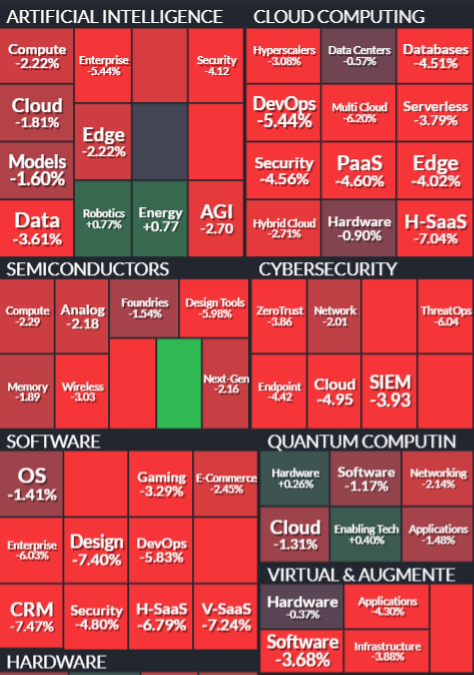
What happened today in software stocks wasn’t a normal rotation. It was the kind of session where fear becomes visible, language changes, and investors stop arguing about valuation and start arguing about exits.
Bloomberg described it as “get me out” style selling. A Jefferies trader even coined the term SaaSpocalypse, and it stuck. This was capitulation-style selling.
So, What Happened?
Anthropic released a productivity tool aimed directly at in-house legal teams, and suddenly a part of the software ecosystem that investors assumed was relatively insulated looked very exposed. Legal software stocks collapsed almost instantly. For example, LegalZoom fell close to 20%. Thomson Reuters (TRI) stock fell about 16%.
Once this type of panic started, the market stopped making distinctions.
By the end of the day, almost every software stock was being sold regardless of whether AI actually threatens its business or not. Companies that benefit from AI, companies that enable AI, companies that barely intersect with it…many of them were treated the same. When that happens, it tells you something important: the market is reacting emotionally, not analytically.
That doesn’t mean there isn’t real risk here. But this kind of selling usually doesn’t happen near market tops. It happens when sentiment has already broken.
It suggests that we’re getting closer to a bottom.
Why This Kind of Panic Matters
Markets don’t bottom when things feel comfortable. They bottom when people feel trapped.
One of the most important signals investors often ignore is how selling happens. Slow, orderly declines are usually part of longer topping processes. Fast, indiscriminate selling across an entire sector tends to show up much later in the cycle, when fear has finally gone mainstream.
That’s what today looked like.
The software sector has been under pressure for months. The IGV ETF (a fund that primarily holds large-cap software stocks) has been performing poorly, roughly 27-28% off its all-time high. Today alone, it was down 4.6%.
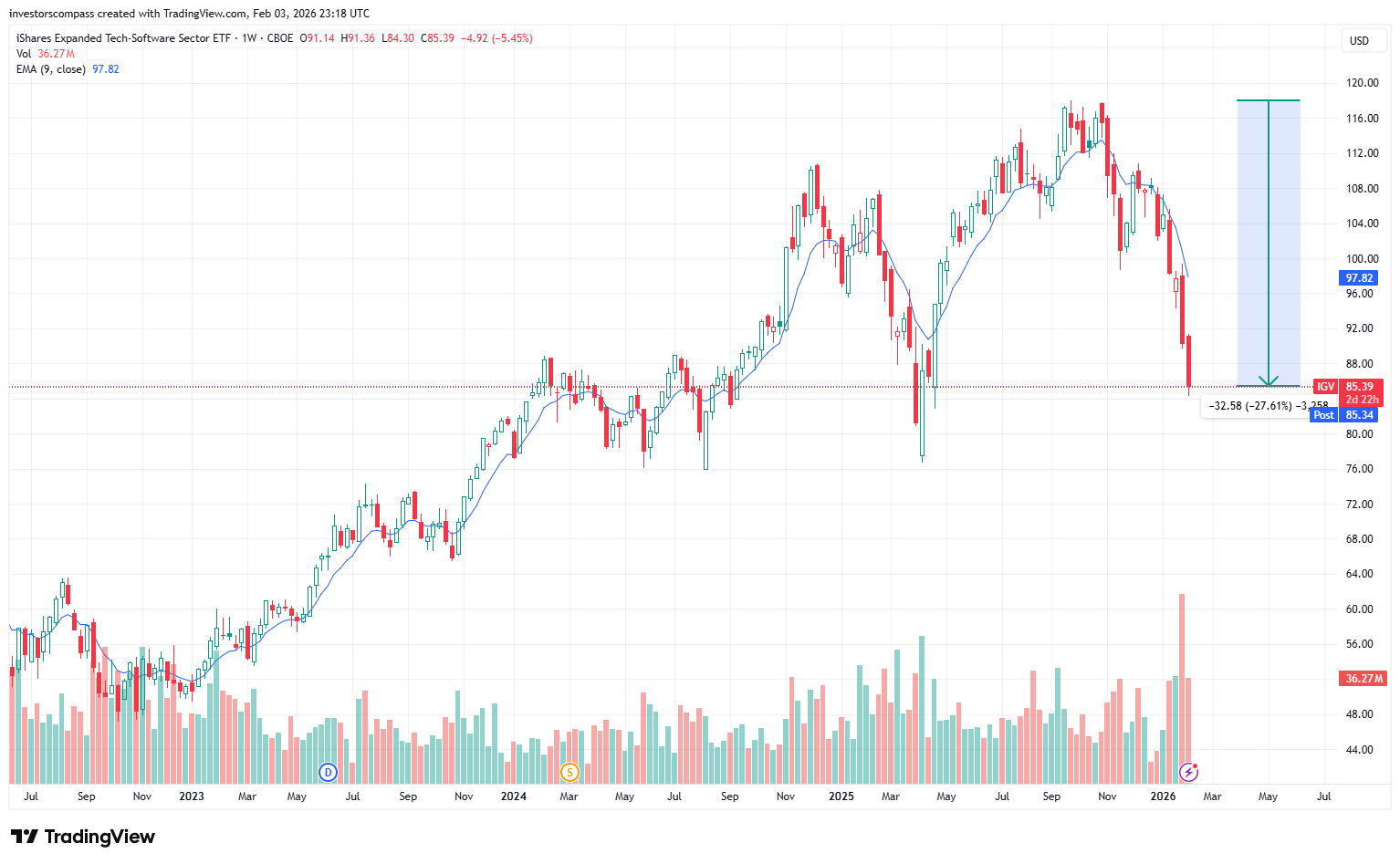
Relative strength has been deteriorating. Growth expectations have been drifting lower. Investors have been quietly reducing exposure. But today was different. Today, traders weren’t asking whether software stocks were cheap. They were asking how bad things could get.
That shift matters. Check out this quote from a Yahoo Finance article. It’s quite telling:
I ask clients, ‘what’s your hold-your-nose level?’ and even with all the capitulation, I haven’t heard any conviction on where that is,” Favuzza said. “People are just selling everything and don’t care about the price.”
For reference, a hold-your-nose level is trader shorthand for the price or valuation where something looks so beaten down that you’re willing to buy it despite still feeling uncomfortable. Think “This still smells bad, but the risk/reward is finally good enough to buy.”
Historically, when investors stop caring about price and just want out, you’re usually closer to a bottom than a top. That doesn’t mean the bottom was today. It does mean the risk-reward ratio is starting to change.
This doesn’t require believing that AI fears are fake. You can fully accept that AI is going to pressure software pricing, compress margins, and wipe out certain business models. Panic doesn’t mean the story is wrong. It means the market is pricing in the most extreme version of that story all at once.
When that happens, nuance disappears. Investors stop distinguishing between software that’s genuinely vulnerable and software that sits at the center of complex, hard-to-replace workflows. Everything gets sold under the same headline.
This is exactly when mistakes get made on both sides.
Bulls rush in too early just because something looks cheap, ignoring the fact that some companies really are facing structural pressure. On the flip side, bears dump everything.
Firms Are Hiring Consultants To Tell Them Which Stocks To Sell
This quote from that same Yahoo Finance article stood out to me. Check it out:
“The concerns are brewing in private equity as well, with firms including Arcmont Asset Management and Hayfin Capital Management hiring consultants to check their portfolios for businesses that could be vulnerable, according to people with knowledge of the matter.”
Not only does that show panic, but it’s just funny to me. Hiring a consultant to tell you which stocks will be vulnerable to AI? If you’re so worried about AI, don’t hire a consultant…use AI to help you shuffle your portfolio ;)
Just found that part interesting.
The Mistake of Treating “Cheap” as a Signal
This is where a lot of investors get themselves into trouble. After a selloff like this, screens light up with “undervalued” labels. Multiples compress. Stocks that once traded at premiums suddenly look reasonable. It feels like opportunity. In the very long term, it could be.
But cheapness by itself is not a catalyst.
I learned this the hard way earlier in my investing career. I spent years buying stocks that looked undervalued based on traditional metrics. Discounted cash flow models, forward P/E ratios, etc. On paper, they looked like obvious winners.
In reality, many of them went nowhere while capital flowed into other parts of the market. I go into more depth on this topic in a recent article titled Why “Undervalued” Stocks Keep Failing You, if you want to check it out.
But the reason is simple. Stocks don’t move because they look inexpensive. They move when expectations about the future change. Without something that forces investors to rethink the outlook, a stock can stay cheap for a very long time.
This is how value traps form, and the SaaSpocalypse is likely creating some of these setups right now. Many software stocks look attractive relative to their past, but the market is anchoring to a less exciting future. In that context, low valuations aren’t necessarily mistakes. They’re often an acknowledgment of uncertainty.
This is why panic selling can coexist with value traps. Some stocks are being oversold indiscriminately. Others are being repriced for legitimate structural reasons. Telling the difference is the entire game.
This next section will help you be able to distinguish that difference.
AI Isn’t Bad for Software. It’s Bad for Fragile Software
One of the biggest errors investors are making right now is assuming that AI is uniformly negative for software.
It isn’t.
AI is bad for software that does one narrow thing, is easy to replicate, and lives on the edge of a workflow. It’s bad for tools that automate routine tasks without owning the broader system. It’s bad for products that can be replaced with an internal build once companies feel confident enough to experiment.
That’s where the fear around “vibe coding” and seat compression comes from.
Think of it like this: imagine a company that used to pay for 20 licenses of a specific software product because each employee needed their own access. Now imagine that AI automates half of that workflow, or acts as a shared assistant. Suddenly, maybe the company only needs 10 licenses instead of twenty. That’s bad for software companies that charge customers based on how many people use the product.
Which Type Of Software Companies Can Benefit From AI?
AI can actually increase the value of software that handles complexity, manages risk, protects data, or sits deep inside an organization’s infrastructure. In those cases, AI makes the system more critical, not less.
The problem is that during panics, markets don’t make fine distinctions. They sell first and analyze later.
CrowdStrike is a great example of this. Let’s talk about it below.
CrowdStrike: A Software Stock Not Negatively Impacted By AI
CrowdStrike is a useful example of a software stock that can actually benefit from AI, but it still sold off 3.9% today and hasn’t been performing well in the past few weeks. Again, that tells you a lot about the fear in this sell-off. Here’s a weekly-timeframe chart below.

So, why shouldn’t CrowdStrike have dipped today (fundamentally speaking)? Well, cybersecurity is not discretionary. It’s not a productivity enhancer that companies can experiment with and roll back if it doesn’t work. It’s a risk management function where failure is existential.
AI doesn’t reduce that risk. It amplifies it.
As AI-generated attacks, phishing attempts, and automated exploits become more sophisticated, the demand for real-time detection and response increases. That makes platforms like CrowdStrike more valuable, not less.
Just as important, CrowdStrike isn’t a simple tool that can be replicated internally with a few prompts. Its value comes from a massive threat intelligence network built over years, deep integrations across enterprise systems, and regulatory expectations around security practices.
So when CrowdStrike sells off with the rest of software, that’s not the market making a careful judgment about its long-term prospects. That’s sector-level panic.
Those are the kinds of dislocations that tend to resolve once fear subsides.
How To Actually Survive This Phase
Surviving the SaaSpocalypse doesn’t mean guessing the exact bottom. It means avoiding the two biggest mistakes.
The first mistake is panic selling after the damage has already been done. That’s how investors lock in losses right before conditions stabilize.
The second mistake is blindly buying anything that looks cheap without understanding why it’s cheap.
The middle ground is where disciplined investors live. Focus on businesses where AI increases complexity rather than commoditizing it. Watch for stocks that stop making new lows even when bad news hits. Pay attention to relative strength, not just valuation.
Most importantly, recognize that markets move in cycles. The last cycle rewarded clean growth stories. This one is forcing investors to think harder about durability, relevance, and adaptability.
That transition always feels chaotic. It always feels scary. And it almost always happens closer to bottoms than tops.
Ask yourself “Who still matters when the dust settles?”
I believe this framework is how you survive the SaaSpocalypse. And eventually, it’s how you profit from it.
Thanks for reading! If you liked this article and found it valuable, please consider subscribing! It will help me out a lot, as articles like this take lots of time to write. Paid stock analysis articles coming soon, so don’t miss out. Best of luck to all of you, and remember, this is just my opinion, not financial advice!
This article was originally written on Substack. You can find the original post here.