Is Bitcoin Still Heading to $0?
Yesterday, Richard Farr, who is a chief market strategist and partner at Pivotus Partners, publicly assigned Bitcoin (BTC) a price target of zero. Not as a joke. A literal $0.00 valuation.
He mentioned how miners “are bleeding cash” and that the network is “horribly inefficient as a transaction processor and wastes tremendous amounts of energy.”

Around the same time, Michael Burry warned about speculative excess, leverage, and the fragility of narratives once liquidity tightens. He essentially said that Bitcoin “has been exposed as a purely speculative asset that failed to become a true hedge against monetary debasement,” per Yahoo Finance.
This comes after Bitcoin’s recent crash, with the price falling over 50% from its high before bouncing today back over $70,000.
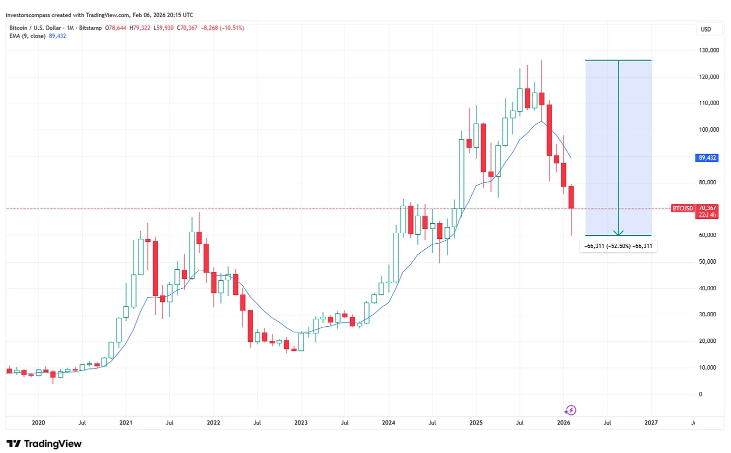
As always, the narratives snapped to extremes. At the top, Bitcoin was inevitable. At the bottom, it was finished.
Either way, this article is not going to make a price prediction. It’s not going to tell you whether Bitcoin will be at $30,000 or $300,000 next year. The real question underneath all the noise is simpler and more uncomfortable:
Is Bitcoin structurally capable of going to zero, or has it crossed a threshold where collapse is no longer realistic, even if many of its grander promises fail?
To answer that honestly, Bitcoin has to be examined the way markets actually work, not the way Twitter threads work: historically, financially, and psychologically.
What Bitcoin Actually Is (and Why That Matters)
Bitcoin is often talked about in sweeping terms. Digital gold. The future of money. An escape from government control. A hedge against inflation, corruption, and monetary debasement.
Strip all of that away and Bitcoin’s core claim is much narrower.
Bitcoin is a non-sovereign, digitally scarce asset that exists outside the direct control of any state. Its rules are enforced by code, not by courts or central banks. It has a fixed supply. It can be transferred without permission. It is extremely difficult to censor at the protocol level.
That combination is genuinely novel. It’s also extremely limited.
Bitcoin does not produce anything. It does not generate earnings, dividends, rents, or interest. It does not represent a claim on labor, land, or productive capital. Unlike businesses or even bonds, there is no stream of output anchoring its value.
That doesn’t make Bitcoin meaningless. It puts it in a very specific category.
Bitcoin’s value comes almost entirely from collective belief that it will continue to be treated as scarce, valuable, and worth holding. That belief can be rational. It can persist for decades. But it’s not self-anchoring in the way productive assets are, like stocks for example…like Viking Holdings (VIK), which I gave a Buy rating to recently and is up 6.2% today ;). You should definitely check out that article.
Anyway, that distinction is important, because it tells us what kind of failure Bitcoin is actually exposed to and what kind it isn’t.
So… Is Bitcoin Actually Going to Zero?
Let’s deal with this directly.
Literal zero is extremely unlikely.
Assets go to zero when they become unusable or when social consensus collapses completely. Bitcoin is unlikely to suffer the first. The network has proven resilient. It has survived bans, exchange collapses, regulatory threats, forks, hacks, and multiple 70–80% drawdowns.
The second condition (a total collapse of belief) is harder. History suggests that once an asset establishes a durable niche, extinction is rare. Even assets that lose their original role often survive in diminished form.
But here’s the key point most debates miss: Not going to zero does not mean “safe,” “inevitable,” or “monetarily central.”
Bitcoin can survive without fulfilling the narrative most holders are implicitly pricing in. That distinction is where almost all confusion comes from.
Store of Value Does Not Mean Permanent
One of the most common crypto assumptions is that once something becomes a “store of value,” it stays one forever. History strongly disagrees.
Across centuries, many things served as stores of value — silver, gold, commodity money, national currencies — only to weaken or lose monetary importance when political, technological, or institutional conditions changed.
Silver is a perfect example.
For centuries, silver was real money across China, the Islamic world, and parts of Europe. It didn’t fail because it stopped being scarce or useful. It failed because institutions moved on. As global trade expanded in the 19th century, gold became more convenient for large-scale settlement. Governments gradually withdrew silver’s legal backing. The U.S. demonetized silver in 1873, triggering the famous “Crime of ’73” backlash.
Silver didn’t disappear. But its monetary role collapsed, and its value repriced sharply relative to gold.
Gold itself tells the same story, just more gently.
Gold is often treated as eternal money, but governments suspended, restored, and abandoned gold standards repeatedly in the 20th century. Britain left gold during World War I, tried to restore it in the 1920s, then abandoned it again in 1931 when it became economically unbearable. The US forced private gold sales via Executive Order 6102 in 1933, devalued the dollar to $35/oz in 1934 (Gold Reserve Act), and Nixon finally severed convertibility in 1971.
Gold survived—but it survived as an asset, not as money.
This is where the common Bitcoin rebuttal misses the point. When someone says, “Gold and silver still went up over time, so why worry?” they are accidentally conceding the argument.
Gold didn’t die. It lost monetary centrality. Bitcoin faces the same risk: survival without dominance.
Why Distrust of Government Isn’t Enough
Bitcoin is powered by distrust of government. That distrust isn’t irrational. Governments inflate currencies, mismanage policy, and abuse power. But history shows that distrust alone does not determine which monetary systems endure.
This is just half of the full article. If you want to read the rest of the full article, check it out on my substack here.