If You Can’t Admit You’re Wrong, You’ll Never Get Rich
Most investors would rather lose money than admit they’re wrong.
They’ll defend a thesis for months. They’ll quote valuation metrics. They’ll blame the macro. They’ll call it “long term.” Anything to avoid saying three simple words: I was wrong.
And that’s exactly why they never get rich.
Now consider this. Peter Brandt has an audited 30-year track record of 41.6% compound annual returns. Not for one cycle. Not during one bubble. Thirty years. At 41.6% compounded for 30 years, $10,000 turns into roughly $370 million.
His best year topped 600%. He had only four losing years, and none of them exceeded a 6% decline.
That kind of asymmetry does not come from stubbornness. It does not come from ego. It does not come from marrying trades. It comes from a rule he has repeated for decades:
Strong opinions, weakly held.
Brandt will form a view aggressively. He will size when the setup is there. And when the evidence shifts, he will publicly say, “I was wrong… so spank me,” adjust, and move on.
That’s not flip-flopping. That’s how you compound.
If you can’t admit you’re wrong in markets, you don’t just hurt your pride. You cap your upside and magnify your losses. And over time, that math is unforgiving.
What Brandt Actually Meant
In July 2011, Brandt wrote a post titled Strong Opinions, Weakly Held. Days earlier, he had published a bearish view on silver, drawing a comparison to the 1980 collapse and suggesting prices could fall toward $20. He felt strongly about it. Then new Commitment of Traders data came out. The positioning backdrop shifted. He began reconsidering.
Naturally, critics jumped on him. How could he be bearish one week and start adjusting the next?
His answer was straightforward: conviction doesn’t mean rigidity.
In that same post, he referenced Barry Ritholtz and the idea that great investors must be able to argue their position forcefully while simultaneously being ready to admit that they’re wrong.
Ritholtz also said:
Being a successful investor often requires you to hold numerous conflicting concepts simultaneously — something many the average psyche has difficulty with.
Brandt made another key distinction: a strong opinion does not automatically equal a trading position. A position requires three things: a well-formed view, a specific technical setup, and favorable reward-to-risk.
Conviction alone is not a trade. Setup and risk control turn opinion into action.
The Public Example That Most Traders Avoid
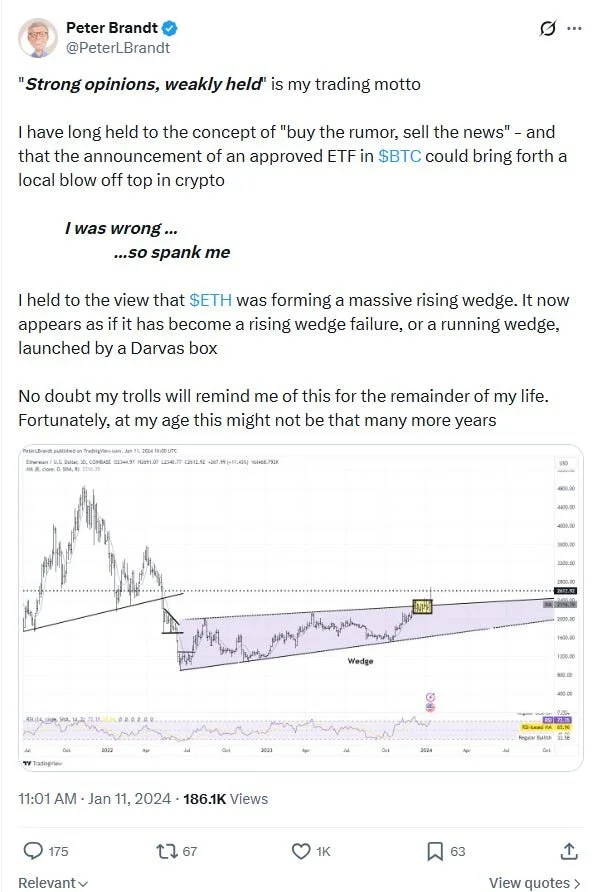
Years later, Brandt reinforced this mindset publicly. In a widely shared post, he reiterated his motto and admitted he had expected a crypto ETF approval to potentially mark a blow-off top. He had also believed Ethereum was forming a large rising wedge. When the pattern evolved differently, he wrote plainly:
“I was wrong… so spank me.”
There was no thread explaining why he was secretly still right. No intellectual gymnastics. No goalpost moving. He updated.
That behavior is rare, and it’s profitable.
Most investors blow up because they refuse to update. They can’t detach from their initial thesis. They confuse being wrong with being incompetent. So they hold. And hold. And hold.
Brandt doesn’t.
Why This Makes You More Money
Markets move when expectations change, not when something looks statistically cheap.
If your framework focuses on catalysts, inflections, and price confirmation, then conviction means recognizing when the probability of expectation shift is rising. It means acting when earnings reaccelerate, when guidance forces repositioning, or when price behavior shows capital rotating in.
That action requires decisiveness. If you wait for complete certainty (flawless data, unanimous bullishness, perfect macro alignment) instead of overall alignment, you will enter after repricing has already occurred.
Conviction allows you to act when the edge appears.
But here’s where weakly held becomes the money-maker.
If the catalyst stalls, if the breakout fails, if the narrative weakens, you exit. You don’t wait years for the market to validate your thesis. You don’t anchor to valuation. You don’t tell yourself that time itself will fix it.
You redeploy into better opportunities.
That capital velocity — cutting stagnation early and reallocating to strengthening names — compounds performance over time.
When commissions were high in the 1970s, discipline was expensive. Today, the only cost of updating is your ego.
Why This Prevents Large Losses
The other side of this philosophy is loss containment.
Every investor has owned something that looked undervalued but lacked urgency. The business wasn’t broken. The balance sheet was strong. Free cash flow was real. But nothing forced expectations higher.
Weakly held conviction forces a question: is the thesis improving, or am I defending it?
If revenue is decelerating and guidance lacks credibility, a low multiple may not be an opportunity. It may simply reflect a slower future. If the chart continues trending lower despite “cheapness,” the market is telling you something about sentiment and expectations.
How long has PayPal been “cheap” for but continues to trend lower?
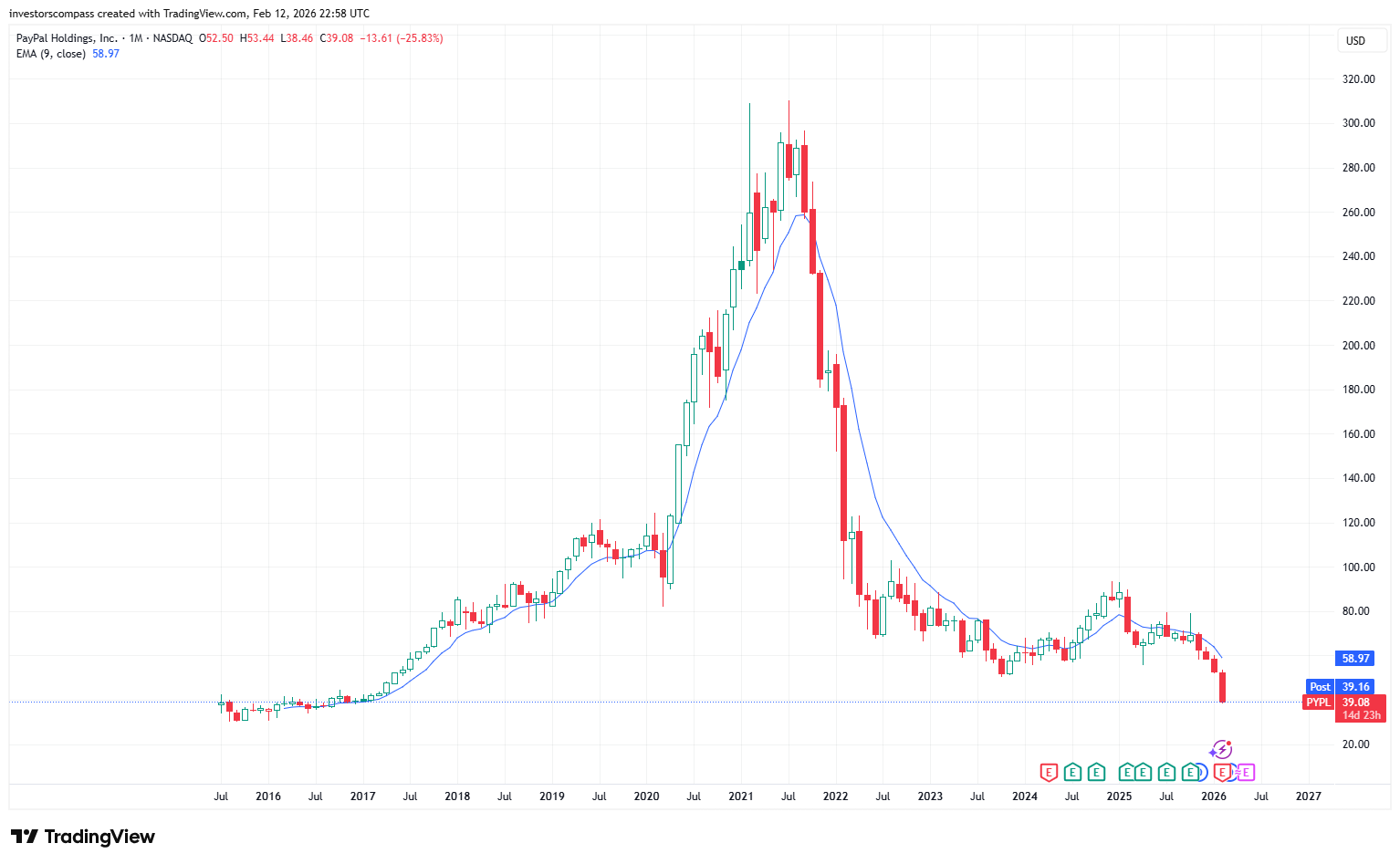
PYPL Stock Chart, Monthly Timeframe
A decade of avoiding dead money can matter more than one extra big winner.
The Compounding Effect
Over a full market cycle, this “strong opinions, weakly held” mindset does two things at once: it lets you press when the odds shift in your favor, and it forces you to step aside before small mistakes turn into career-level damage. More time in leaders. Less time defending losers. That asymmetry is where real compounding happens.
One 50% loss requires a 100% gain to recover. Avoid just three of those over a decade and your compounding curve changes permanently.
Most investors focus on finding the perfect stock. Far fewer focus on building the mindset that protects and reallocates capital efficiently.
Brandt’s mantra isn’t about sounding smart. It’s about staying solvent, staying flexible, and staying in the game long enough for edge to compound.
Strong convictions, weakly held, is not just a motto.
It’s a survival rule that quietly increases returns while dramatically limiting the size of your mistakes.
This article was originally written on Substack. You can read the full article here.