The System Can't Keep Up With AI
Think back to February 2020. You were watching the Superbowl, the virus was “far away,” life felt normal, and then the world changed in a few weeks. That’s the idea in Matt Shumer’s “Something Big Is Happening” article on X, which recently went viral
The core argument is simple: AI’s acceleration will catch people off guard and displace white-collar jobs faster than most expect.
There’s no doubt that AI is improving quickly. What’s changed over the past year is that the improvement doesn’t feel incremental anymore. The shift from AI as a helpful assistant to AI as an autonomous helper capable of handling multi-step workflows has happened faster than most institutions were prepared for.
Coding models now generate production-grade software. Legal systems draft contracts and flag risk clauses in seconds. Financial analysis, like what I do here at Investor’s Compass, can be structured, modeled, and stress-tested automatically. But honestly, it still has its limits here and there. Still, AI isn’t “just” responding to prompts anymore.
The reality is this: the junior analyst you just hired can now be partially replaced by a $20/month subscription.
And yes, AI is now helping build the next versions of itself. Model developers openly say they use AI to debug training runs and refine future systems. That’s a feedback loop. Feedback loops compound.
It was a key point from Matt Shumer’s article — a point that tells you much of what you need to know:
On February 5th, OpenAI released GPT-5.3 Codex. In the technical documentation, they included this:
“GPT-5.3-Codex is our first model that was instrumental in creating itself. The Codex team used early versions to debug its own training, manage its own deployment, and diagnose test results and evaluations.”
Read that again. The AI helped build itself.
At the same time, hyperscalers are pouring tens of billions of dollars annually into AI infrastructure like GPUs, data centers, long-term energy contracts.
Check out Amazon’s capital expenditure (CapEx) figures, for example. $131.8 billion of spending in the past year, and it’s only growing. Same with other big tech companies.
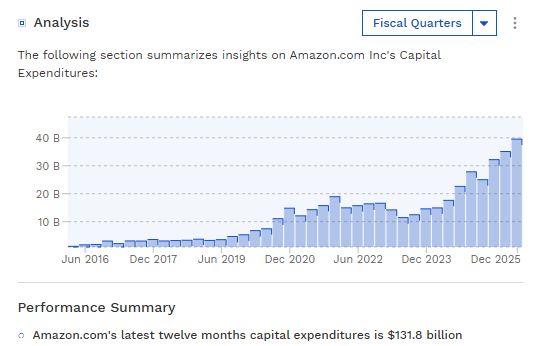
This isn’t a side project inside Big Tech. It’s the largest coordinated capital deployment in the history of computing.
The capability curve is steep, and the capital curve is reinforcing it. When you combine compounding intelligence with compounding investment, acceleration stops being theoretical.
But acknowledging acceleration doesn’t automatically mean accepting imminent economic collapse. The real issue isn’t whether AI is improving. It clearly is. The issue is whether the economic and institutional systems built over decades can adapt at the same speed.
Markets Are Reacting Before Workers Do
If you want evidence that something structural is shifting, look at software stocks. The recent “SaaSpocalypse” sell-off (which I wrote about here) wasn’t random volatility. It was a repricing of risk.
When AI tools began targeting legal research, coding workflows, and enterprise analytics, shares of companies built around those services fell sharply. Investors began pricing in seat compression (fewer employees needing fewer licenses). Analysts started questioning pricing power and competitive moats. Even companies best positioned to benefit from AI infrastructure spending faced scrutiny as CapEx surged and margins compressed.
Markets don’t wait for layoffs to show up in employment data. Stocks reprice before résumés do. If AI reduces the number of humans required to generate the same output, growth assumptions change. If competition increases because AI lowers barriers to entry, multiples adjust.
Labor markets move slower. Firms don’t restructure entire divisions the week a new model launches. Budget cycles, compliance requirements, internal politics…these introduce inertia (a tendency to do nothing or to remain unchanged). Markets reprice in days. Organizations adapt in quarters or years. That mismatch is where volatility begins.
Capability Curves vs. Institutional Curves
Much of today’s anxiety comes from the sense that we’re entering the acceleration portion of an S-curve. If you don’t know what an S-curve is, it shows slow initial growth, rapid acceleration, then slowing expansion as saturation approaches, illustrating how innovations, technologies, or markets evolve over time.
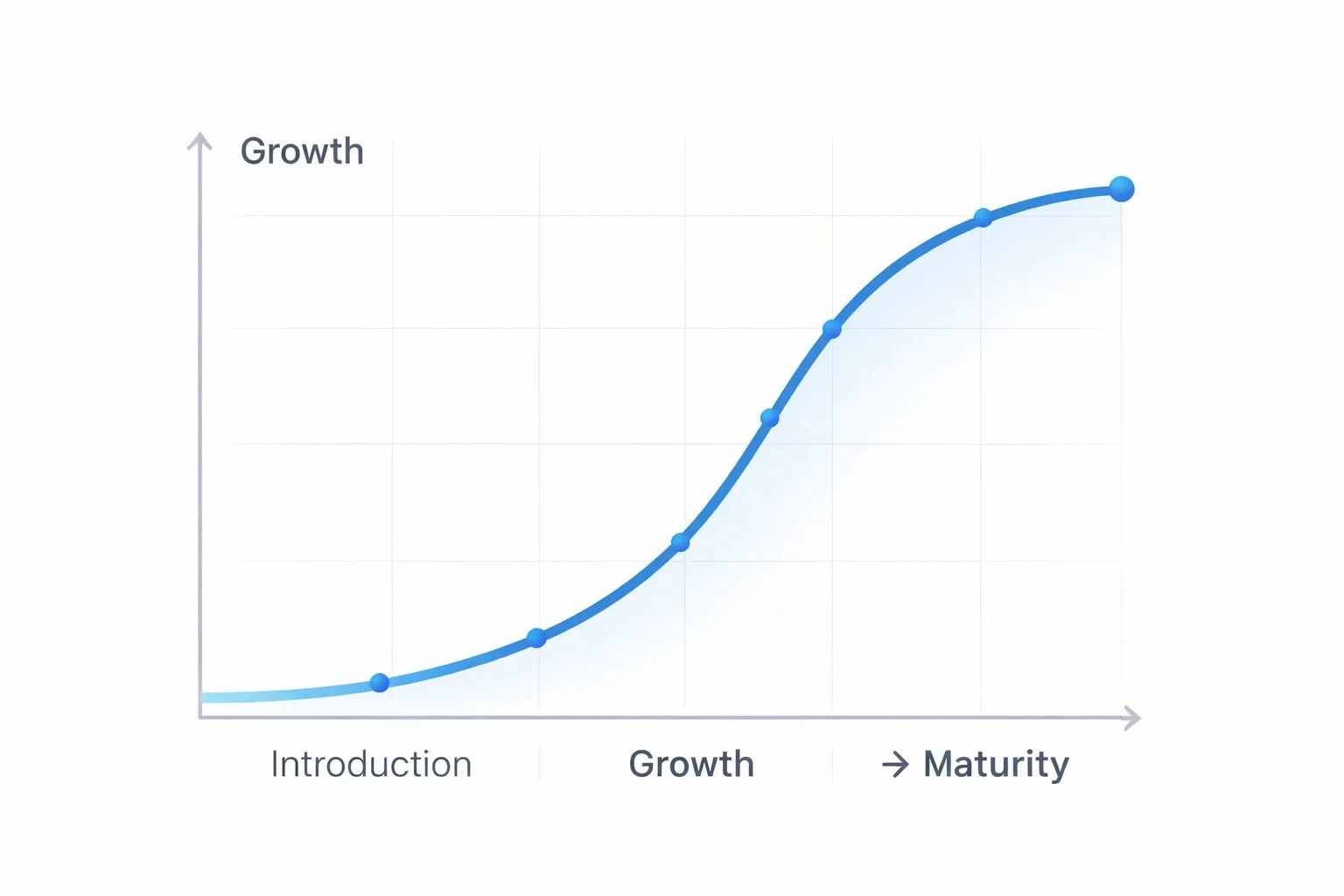
Anyway, on the capability side, it appears to be accurate that we’re in that part of the S-curve.
That’s because AI isn’t just adding features. Tasks that once required constant human oversight can now run autonomously for hours. Improvements in training, scaling, and architecture are pushing performance boundaries quickly.
But here’s the distinction: there’s a difference between capability curves and institutional adaptation curves.
Models improve monthly. Organizations don’t restructure as fast. Legal frameworks evolve over years. Political systems react on election cycles. Even if AI performs a task at 120% of human capability, that doesn’t mean companies instantly eliminate the associated roles.
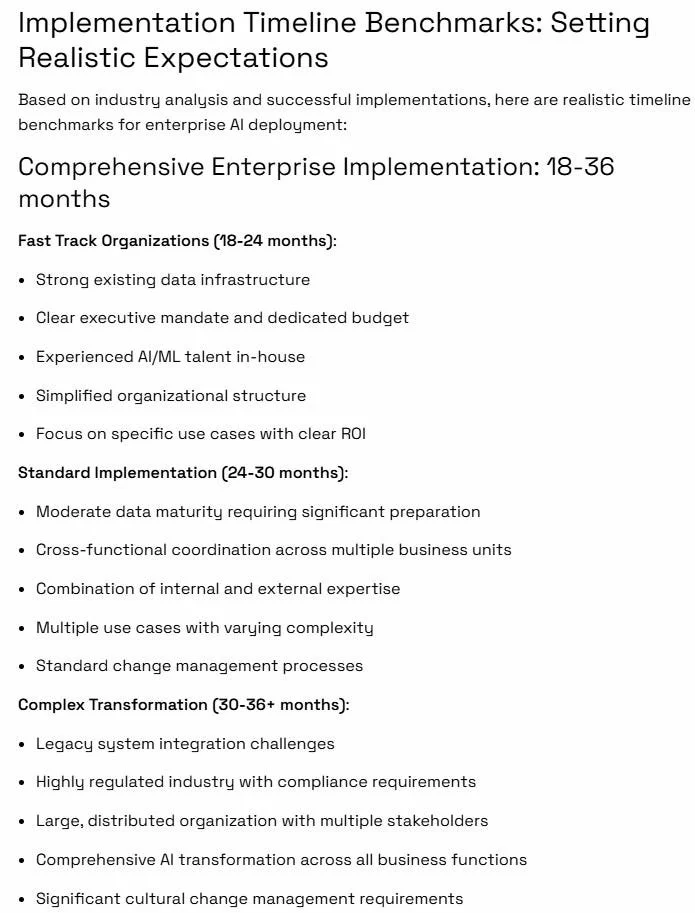
The enterprise AI roadmap from Promethium I screenshotted below makes something clear: large organizations don’t flip a switch when they adopt AI. They move in phases.
Entry-Level Jobs Will Be Hit First
My guess is this: within the next 3-5 years, entry-level white-collar hiring in major industries will decline meaningfully.
Most white-collar careers are ladders. You start at the bottom doing structured, repetitive cognitive work. Drafting first-pass documents. Writing boilerplate code. Compiling research. Building early financial models.
AI can now do a lot of that quickly and consistently. Senior partners won’t be replaced first. The ladder underneath them will shrink. And when the bottom rung disappears, the entire structure eventually changes.
A startup founded today can operate with far fewer people than a similar company five years ago. Honestly, if I was starting a business today, I’d do my best not to hire anyone and just use AI. I’m sure many business owners feel the same.
Large firms may not announce sweeping layoffs right away. They still have legacy systems, compliance rules, and internal processes. Replacing or restructuring those takes time.
But still, they might freeze hiring. Shrink grad intakes. Let attrition reduce headcount. And fewer entry-level roles today means fewer senior professionals tomorrow.
That doesn’t mean no displacement is occurring, though. AI fears drove 55,000 U.S. layoffs in 2025, per Challenger, Gray & Christmas. Even some executives are signaling how large the longer-term shift could be. Ford’s CEO predicted last summer that half of white-collar jobs would be gone eventually.
Politics Won’t Stay On The Sidelines
If AI starts reducing real opportunities in white-collar work, the impact won’t stay purely economic. Political systems will respond. When large groups of people feel pressure (fewer jobs, slower wage growth, harder entry into professions) governments step in.
We’ve already seen early debates around AI regulation. Governments don’t move as fast as tech companies, but they eventually respond. The economy isn’t just about profits and markets. It’s also about fairness and stability. If AI starts taking jobs or putting serious pressure on wages, politicians could step in. That could mean new rules, taxes, or restrictions. And government action usually moves even slower than corporations do.
The Takeaway
AI is clearly accelerating. That part isn’t debatable anymore. The real question is what happens when technological capability begins compounding faster than the systems built to absorb it. Markets are already adjusting. Hiring patterns are beginning to shift. Startups are reorganizing around AI from day one. Large institutions are moving more cautiously, but they are moving.
This doesn’t mean the economy collapses next quarter. It also doesn’t mean everything continues as normal. What it likely means is a period of tension where productivity rises, margins shift, entry-level opportunities shrink, and political pressure builds before the system fully stabilizes. The adjustment won’t be a single dramatic event. It will be uneven, sector by sector, company by company.
Acceleration is here. Adaptation is slower. And the gap between the two is where volatility, opportunity, and disruption will live over the next while. The smartest move isn’t panic. It’s paying attention and positioning accordingly. Positioning accordingly is what I try to help with when writing this newsletter.
Thanks for reading! If you liked this article and found it valuable, please consider subscribing! It will help me out a lot, as articles like this take lots of time to write. Best of luck to all of you, and remember, this is just my opinion, not financial advice!
This article was originally posted on Substack. Find the original article here.